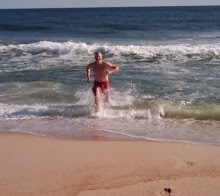
Happy Summer. Today is the solstice and the official beginning of summer. Summer for me has always involved the ocean, happily. The ocean rejuvenates body and soul like nothing else. We feel the tug as we are drawn to our original home. It breathes life.
The solstice is also the longest day of the year. I’m going to enjoy the long light across the green-blue waves and the smooth-soft dunes, stand where land meets sea, gaze into it, and soak it in.
Monday, June 21, 2010


Saturday, June 19, 2010
No Apologies
US Representative Joe Barton, who apologized to BP for the big bill they're getting, is the kind of person we need to be leave behind as the US moves to a renewable energy economy.
Surprise, surprise, according to the New York Time: Individuals and political action committees in the oil and gas industry have been Mr. Barton’s biggest source of campaign money, it reported, contributing $1.4 million since the 1990 election cycle.
Of course he publicly apologized for his apology because the Republican powers told him to do so immediately.
We can't expect the Joe Bartons of the world to show the kind of leadership or political courage necessary to move the US to a renewable energy economy. He's steeped in the old ways, stuck in the status quo.
He's as outdated as those clunky first mobile phones. Remember those things? Imagine if the technology industry was as entrenched in its ways as much as the petroleum industry and automobile industry. Imagine if we still had computers the size of rooms.
The combustion engine essentially hasn't changed in over 100 years. Still fueled by petroleum and still running around on four wheels, rubber against road. No need for major changes as long as the petroleum and automotive folks are making trillions.
Joe Barton should get into his Model T and go home. He is obviously part of the problem, not part of the solution.
No apologies.
Here's the full NYT story on his apology:
http://www.nytimes.com/2010/06/18/us/politics/18barton.html?ref=todayspaper
Friday, June 18, 2010
Viva La Evolution
In reference to the post here a few days ago In Case You Missed It -- the Time is Now, Jon Stewart reminded me that every American President since Nixon made a call to arms to end America's dependence on foreign oil. Obviously, nothing was done (although Nixon needs to be credited with signing the Clean Water Act, the Endangered Species Act, and creating the Environmental Protection Agency).
How is Obama's semi-tough speech this week any different?
Off the cuff, the difference is people are getting it, really getting it, that the US's addiction to petroleum is bad on several levels. Reagrdless of which side of the aisle you sit, pick your issue and petroleum is there. National security, the economy, the environment.
There is nothing to say though that Congress will actually come through. Ideally, those people we elected would initiate a Carbon tax, remove petroleum subsidies, and make the tough decisions, show the political courage, and imagine this -- the leadership -- necessary to move this country to a renewable energy economy. Not by 2025, not starting in 2015, but now. Now is the time.
Yes, we will still need petroleum for quite some time, but there is a difference between continuing our addiction and weaning ourselves of it.
It's not all on the politicians, either. We the people must show our own kind of courage and try everyday to see the big picture. And we must stay focused and not let oursleves get distracted by the naysayers. Naysayers often have their own agendas; there are a lot of people making a lot of money on the status quo of the petroluem economy, and they have no interest in changing. It's time to find new ways to make money in the renewable energy economy, and leave behind those unable or unwilling to evolve.
We certainly can't rely on petroleum companies. Don't listen to them. They're still making billions of dollars giving us what we've always wanted, or what the infrastructure juggernaut has fed us for nearly a century. Automakers, too. Been there, done that. Time to shift our demand and our habits and evolve into a smarter, cleaner, and safer society. Send the message in our buying habits, our votes, and our voices. Let's move on.
Thursday, June 17, 2010
Happy Birthday (Belated) Jacques

His 100th birthday was last week and in honor, his ship the Calypso was re-launched. With his siganture red cap, the smiling explorer fascinated generations with the deep blue. It's a little belated, but Happy Birthday Jacques.
Ever since "The Silent World" hit movie screens around the world in 1956, Jacques Cousteau (1910 – 1997) and his red cap have been synonymous with ocean exploration.
Sailing around the world on his iconic ship Calypso, Cousteau captivated audiences with the unknown ocean and inspired future generations of ocean explorers. Friday marks the 100th birthday of Jacques Cousteau, whose legacy still lives on in the quest to unravel the ocean's mysteries.
Commander Cousteau's prolific career includes over 120 television documentaries, 50 books and the 300,000 member environmental foundation, the Cousteau Society.
"He shared his passion for the liquid abyss with hundreds of millions around the world," said Cousteau's grandson, ocean filmmaker Fabien Cousteau.
Pop-culture crossover
As the pioneer in underwater documentaries, Cousteau won Oscars for "The Silent World," "The Golden Fish" and "World Without Sun." He also won two Cannes Film Festival awards, including the Palme d'Or — the festival's top award — for "The Silent World." His television series "The Cousteau Odyssey" received two Emmy Award nominations.
The highest civilian award in the United States, the Presidential Medal of Freedom, was awarded to Cousteau by President Reagan in 1985 and 1989. Cousteau was granted membership into the French Academy, France's preeminent scholarly body, in 1988.
Perhaps a more lasting tribute than awards and honors, Cousteau was a crossover star and is eponymous in popular culture. He has been name-dropped in even the most unlikely places, including in songs by the hip-hop group Wu-Tang Clan and the rock band Incubus. Even John Denver wrote a song called "Calypso" as a tribute to Cousteau and his crew.
In Star Trek, the captain's yacht of the USS Enterprise-E is named Cousteau. The 2004 film "The Life Aquatic with Steve Zissou" is equal parts homage and send-up of Cousteau's career.
Birth of a legend
The legendary ocean explorer was born Jacques-Yves Cousteau on June 11, 1910 in Saint Andre de Cubzac in southwest France.
At 33 years old, Cousteau and Emile Gagnan invented a device that allowed divers to plunge deeper into the ocean than ever before — the aqua-lung.
On a small beach along the French Riviera, Cousteau donned the first completely autonomous diving gear. He modified a regulator to supply divers with breathing gas on demand and at the proper pressure. This prevented the tanks from quickly running out of air, and was the crowning piece of the first Self-Contained Underwater Breathing Apparatus (SCUBA).
The invention allowed Cousteau and his divers the "freedom of flight underwater," said Fabien Cousteau. "He invented the tools that unchained man from the surface."
Despite having tools to explore deeper into the ocean than ever before, scuba diving only allows explorers to skim the ocean's surface. The record for scuba diving on compressed air is 509 feet (155 meters) below the surface. The deepest part of the ocean, at the Mariana Trench, is 35,814 feet (10,916 m). This part of the ocean has only been visited once, in 1960, by the bathyscaphe (deep boat) Trieste.
Water covers 70 percent of the Earth's surface, but what lives within the ocean's layers is still largely a mystery.
"Today we still know more about outer space than our ocean world," Fabien Cousteau said.
It's not due to a lack of interest on behalf of audiences. Today, TV events such as Discovery Channel's "Shark Week" draw big ratings numbers. But while these shows may be set in the ocean, they don't inspire the same adoration for marine life as Cousteau's underwater adventures.
"We don't have Jacques Cousteau's passion splashed across the screen daily, so people today are both terrified of and in love with oceans," said David Guggenheim of the Ocean Foundation.
Jacques Cousteau's exploration inspired people to care about the ocean, Guggenheim said, , and he firmly believed that "people protect what they love."
100 years of Cousteau
Cousteau's centennial celebration includes events that will attempt to recapture that spirit. The celebration is a year-long event highlighted by plans to re-launch the Calypso for a marine education tour.
In conjunction with the celebration, The Cousteau Society is developing an ocean monitoring program. Called Cousteau's Divers, the program will unite a community of divers that are concerned about the marine environment.
To bring the message of ocean conservation to people's living rooms, the National Geographic Society will begin a one-month filming expedition in the Mediterranean Sea. Sailing aboard the Cousteau Society Ship Alcyone, the film's goal is to document changes that have occurred in the Mediterranean since Cousteau's early films of the 1940s.
By Brett Israel
Link to story: http://www.csmonitor.com/Science/2010/0611/Jacques-Cousteau-s-legacy-lives-on
Tuesday, June 15, 2010
In Case You Missed It -- the Time is Now
Did you see President Obama's Oval Office speech about the Gulf tonight?
The second half of his speech was the best because he talked directly about accelerating our transition to the clean energy economy. Nothing particularly eloquent or dramatic or profound but actually exciting for anyone looking for a better future and an end to America's addiction to petroleum.
"The most painful and powerful reminder yet that the time to embrace a clean energy future is now."
Lots of people will say that's just talk, let's see the plan, something tangible, but part of the job of leaders is to talk about the big ideas, to inspire, and to throw down the challenge to everyone.
"I make that commitment now tonight"
"political courage"
"the clean energy future is now"
"act now"
it is a matter of "national security, our economy, and our environment"
That last phrase comes with great potential. The clean energy economy has value propositions within the above 3 categories, categories that appeal to different kinds of people, and that may get us there.
You don't like the US's vulnerability to foreign fossil fuels (we consume over 20% and produce less than 2%)? The clean energy economy can happen domestically.
You don't like young Americans dying in the name of petroleum dressed up as democracy and stability? Clean energy economy.
You don't like the US losing its global edge to China (China invests already 6 times more than the US in clean energy)? Clean energy economy.
You don't like climate change and/or the destruction of the Gulf of Mexico ecosystems? Clean energy.
This is not some far off dream. This is not a fantasy. It's very real and it's now.
Monday, June 14, 2010
Is Bethuene a Noble Warrior or a Liability?
As a diversion from the Gulf catastrophe, some interesting news from the anti-whaling front recently.
Sea Shepard has dropped its affiliation with anti-whaling activist Peter Bethuene because he allegedly boarded a Japanese whaling ship with bow and arrows, or brought bow and arrows on an anti-whaling campaign. This brings up a bigger question -- these are the guys who harrass the Japanese whaling fleet, you may have seen them on Whale Wars on TV.
What do we think about all of this?
Maybe Bethuene is a fringe element who undermines the efforts of environmentalists everywhere who are trying to develop dialogues, work within the system, use the tools of science and legislation to make real change, etc. They are doing good work. Credibility is damaged. Maybe now it's just as hard to be taken seriously if labeled a "whale lover" as it is with "tree hugger". But that's the opposition who came up with those words.
Maybe Bethuene is on the front lines of environmental activism, and he was thinking they've got harpoons, so I'll bring my own. Maybe he wasn't thinking at all. He was just acting.
Maybe Bethuene knows that environmentalists seem to be losing the war and maybe he should be lauded for trying to win a battle. We can sign our petitions and write our blogs and have out protests (as long as we have the proper permits) but environmentalists may be too soft, too compliant. It can't always be pretty.
Sea Shepard has a policy of no weapons and that's the motivation for dropping Bethuene. So he broke policy. But aren't the rancid butter "bombs" and the ship itself weapons in the fight against illegal whaling?
But it's not really illegal because the Japanese have found a loophole in international law. The Japanese are culling these whales for research purposes. Really?
Whales are fantastic, charismatic creatures, and many of them are scarce and endangered. Can't we just leave them all alone?
Here is the news about it:
According to a ABC news online report: "The Sea Shepherd Conservation Society has cut its links with anti-whaling activist Peter Bethune after he carried a bow and arrows during confrontations with Japanese whalers in the Southern Ocean.
The New Zealand-born activist and former Ady Gil skipper is currently on trial in Tokyo after being arrested when he forced his way on board a whaling vessel in Antarctic waters in February."
http://www.abc.net.au/news/stories/2010/06/08/2921909.htm?section=justin
Friday, June 11, 2010
Twice the Nightmare
It might be twice as bad as we think -- BP's disaster may have spewed twice as much petroleum into the Gulf as we were previously told or thought.
According to the Associated Press:
HOUSTON - New figures for the blown-out well at the bottom of the Gulf of Mexico show the amount of oil spewing may have been up to twice as much as previously thought, according to scientists consulting with the U.S. government.
That could mean 42 million gallons (160 million liters) to more than 100 million gallons (380 million liters) of oil have already fouled the Gulf's fragile waters, affecting people who live, work and play along the coast from Louisiana to Florida — and perhaps beyond.
It is the third — and perhaps not the last — time the U.S. government has had to increase its estimate of how much oil is gushing. Trying to clarify what has been a contentious and confusing issue, officials on Thursday gave a wide variety of estimates.
All the new spill estimates are worse than earlier ones — and far more costly for BP, which has seen its stock sink since the April 20 explosion that killed 11 workers and triggered the spill. Most of Thursday's estimates had more oil flowing in an hour than what officials once said was spilling in an entire day.
"This is a nightmare that keeps getting worse every week," said Michael Brune, executive director of the Sierra Club. "We're finding out more and more information about the extent of the damage. ... Clearly we can't trust BP's estimates of how much oil is coming out."
The spill was flowing at a daily rate that could possibly have been as high as 2.1 million gallons (8 million liters), twice the highest number the federal government had been saying, U.S. Geological Survey Director Marcia McNutt, who is coordinating estimates, said Thursday. But she said possibly more credible numbers are a bit lower.
Story by Harry Weber, Seth Borenstein
Wake me please!
Subscribe to:
Posts (Atom)



 Posts

